

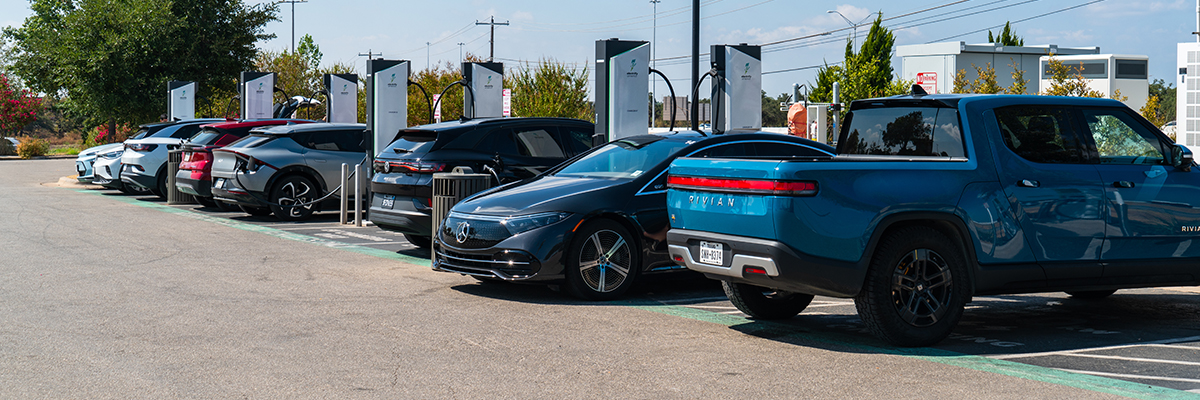
Commercial EV Charging: Level 2 vs DC Fast Charging
As more consumers are opting for electric vehicles (EVs) and companies are electrifying their fleets, the need for public charging infrastructure is increasing. In fact, public EV charging infrastructure has grown rapidly over the last decade; as of July 2026, there were over 80,000 EV charging stations with more than 250,000 charging ports across the country.* That’s a 6% increase in the number of stations in just a year.
This steady increase in EV adoption is creating opportunities for electrical contractors across multifamily dwellings, commercial businesses, and public spaces.
As an electrical contractor, you may be the one recommending a charger type based on the way the site is used and its electrical capacity — making it important to brush up on the following charger type basics.
Charging Station Differences
While the majority of public charging port types are Level 2 chargers, the number of DC fast charging ports (Level 3) has been growing by about 30% year over year.
Determining the best option for a customer depends on which option best aligns with the charging needs of the vehicles utilizing the ports.
Level 2 Charging
In Level 2 charging, electric power goes directly to the vehicle. The vehicle converts that power to DC, or battery power, using an onboard converter.
Level 2 Charging Essentials
- Typical power range: 7.2 kW–19.2 kW
- Uses 208V or 240V service
- Adds approximately 20–40 miles of range per hour
Convenience matters more than speed for Level 2 charging. Level 2 charging is often sufficient for locations where vehicles are going to be parked for up to 10 hours. Common applications include employee parking lots, apartments and multifamily housing, hotels, boutique and small retail locations, and fleet vehicles parked overnight.
DC Fast Charging
DC fast charging sends high-voltage direct current straight to an EV’s battery.
DC Fast Charging Essentials
- Typical power range: 50 kW–350+ kW
- Uses high-voltage DC (400V–900V)
- Converts power within the charger
- Adds significant range in minutes instead of hours, with approximately 100–250+ miles of range added in less than 30 minutes
DC fast charging is ideal for quick-turn locations where charging speed is crucial, including delivery fleet depots, transit operations, convenience stores, large retail locations, the auto industry, and high-turnover commercial sites.
Planning Considerations
When it comes to commercial EV charging station projects, the electrical contractor is crucial for identifying electrical constraints, installation requirements, and upgrade costs during an early feasibility review. It’s also important to keep scalability in mind to take advantage of utility incentives and avoid costly retrofits in the future.
If you’re involved in such a project, having some high-level information from the outset — like the answers to these basic questions — is a good starting point for determining whether the project is better suited for Level 2 or DC fast chargers.
How much space is available?
The location of the chargers is just as important as the number being installed. Parking, traffic, ADA requirements, and existing buildings should all be taken into account. The customer might have enough space for a lot of Level 2 chargers, but only enough space for a couple of DC fast chargers.
How many chargers does the site require?
Determining the ideal number of chargers for a site depends on a variety of factors, including the average dwell time, existing electrical service capacity, the local EV adoption rate, and state or city codes.
What are the installation needs?
While installation needs for Level 2 charging typically require conduit and wire, breakers, and basic commissioning, DC fast charging may require service and switchgear upgrades, new transformer capacity, and medium-voltage coordination. And that translates to utility upgrades, longer lead times, higher costs, and more complex commissioning.
Does the utility provider offer incentives for EV charging station installation?
Some utilities offer make-ready or other incentives to help reduce the upfront costs of building Level 2 and DC fast charging stations.
Sources: *The Motley Fool, July 2026; Fuel Cell Works, June 2026 / Alternative Fuels Data Center
Related Posts


Connect with our team
Visit your local Crescent Electric location or fill out the form below to connect with our team.