

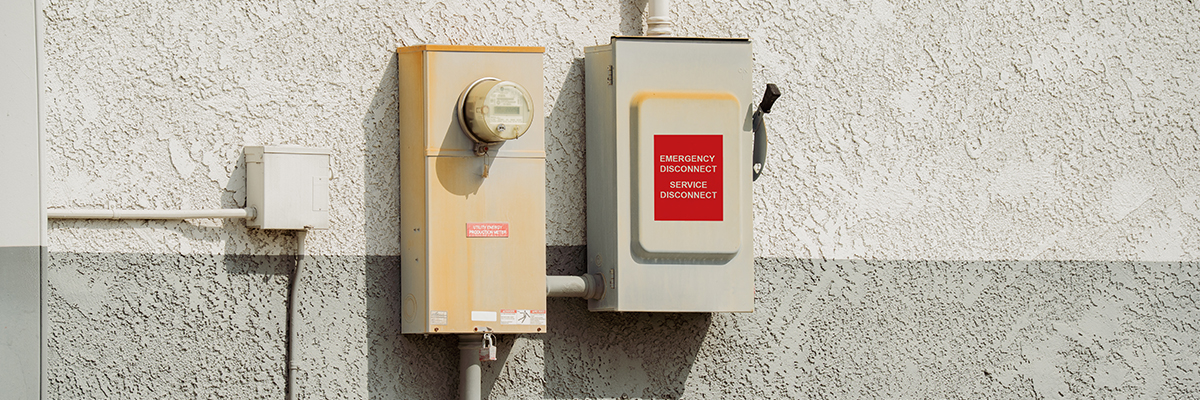
Emergency Disconnects: Commonly Missed Code Details
The 2026 National Electrical Code (NEC), issued in September 2025, deleted section 230.85 about emergency disconnect requirements for one- and two-family dwellings. The code didn’t eliminate those requirements, but instead consolidated them into section 230.70, which covers general requirements on service disconnecting rules.
The reason for the change? Requiring that the service disconnecting means serve as the emergency disconnect resolves questions that came with section 230.85 around grounding and bonding rules (among others), because service equipment is already required to be properly bonded and protected.
Because this change is new, it can be easy to overlook important specifics for staying compliant. To help you meet code and maintain safe practices, check out the five commonly missed details below. (Make sure you confirm your local code, as individual states may make exceptions to parts of the code.)
Missed Detail #1: Installing the service disconnect outdoors
While the previous NEC edition required the service disconnect to be installed either outside of a dwelling or inside the nearest point of entrance of the service conductors, that’s no longer the case. Under 2026 NEC 230.70(A)(1), the service disconnect for a one- or two-family dwelling must be:
- Outdoors
- Readily accessible
- On the dwelling unit or within sight of the dwelling unit (in accordance with 110.29). One exception: You don’t need to install the service disconnect on or within sight of the dwelling unit when an emergency disconnect is installed in accordance with 225.41 (feeder-supplied dwellings).
Missed Detail #2: Installing the service disconnect where it’s easy to access
A disconnect installed outdoors, but behind locked gates, landscaping, above a reachable working height, or obstructed by HVAC equipment will fail inspection, as first responders need easy access to the disconnect.
Missed Detail #3: Installing the service disconnect where you can see it
Keep in mind that installing the service disconnect “within sight,” means it needs to be visible from the dwelling and not more than 50 feet away. Do not install the service disconnect around a corner, behind a detached garage, or on a structure that’s too far away.
Missed Detail #4: Misapplying the feeder-supplied dwelling exception
Not every detached structure or remote service qualifies for the feeder-supplied dwelling exception. This exception only applies when the disconnecting means already meets the requirements of being readily accessible and located outdoors on or within sight of the one- or two-family dwelling.
Missed Detail #5: Proper labels
Under 2026 NEC 230.70, you must mark service disconnects with “SERVICE DISCONNECT” on or adjacent to the service disconnect.
You must also mark enclosures of disconnects for one- and two-family dwellings with “EMERGENCY DISCONNECT.”
The marking needs to be on the outside front of the disconnect enclosure with a red background and white text; the letters need to be at least ½ inch high.
Meeting Codes Starts with the Right Support
Staying compliant with the NEC is paramount for any job. Crescent Electric local teams are knowledgeable, experienced, and ready to help you select what you need to keep you, your workforce, and your customers safe.
Visit your local Crescent Electric location or fill out the form below to connect with our team.